
I’ll admit; I’ve barely paid attention to Earth Day before. Maybe we sang a song about it in elementary school, but that’s probably it. In my quest to become more “woke” about the environment, I can no longer live my life without thinking about the impact I’m having on the Earth. Climate Change is here, peeps. I’ve seen it on TV as people were evacuating in Houston and Florida, I’ve seen it in my coworker’s eyes as she described her neighbors in Puerto Rico, I’ve seen it in my own city as Boston experienced three Nor’easters in two weeks and experienced flooding downtown.
There are so many different categories to focus on when it comes to the environment – greenhouse gases, deforestation, pollution, rising sea levels, etc. What is frustrating is that sometimes the problem can seem so huge, that its too overwhelming to wrap our heads around. Or we think that there is nothing we can do; it’s up to the government to fix it. Or the problem is too far away and disconnected from our daily life (what can I do from Massachusetts to help starving polar bears in Antarctica? Not much).
However there ARE things we can do today to start making a difference. Individual action and activism is where it starts, and while it’s true that we need governments and corporations to really move the needle, that is no reason to sit back and give up.
This Earth Day, and every day, let’s take a stand and decide to live our lives in a way that isn’t detrimental to the environment and other people. The average American generates 4.4 pounds of trash PER DAY. Generating trash doesn’t just have to be a fact of life, there are things you can do about it. In order to do that, I’m revisiting the “reduce, reuse, recycle” guidance that we’re all familiar with. It’s evolved quite a bit, and while there are different variations, my favorite is actually 5 R’s – Refuse, Reduce, Reuse, Recycle and Rot. Read on for how I abide by the 5 R’s, and some ideas for how you can start incorporating them into your life to start being a more conscious global citizen.
The 5 R’s
- Refuse

The first step in being eco-friendly and reducing your impact is to refuse things from entering your life in the first place. If you don’t have something, you don’t have to dispose of it – magic! Here are some ways to refuse:
- Refuse to take free tchotchkes from events – these are just junk!
- Refuse a Styrofoam cup around your Dunkin Donuts iced coffee (looking at you, New Englanders). Also – see “reuse”
- Refuse plastic bags while shopping
- Refuse to get a straw in your drinks at restaurants – just tack it onto the end of your order, and be polite: “I’ll have a ice tea, unsweetened, with no straw – please!”
- Refuse unnecessary packaging – buy flowers with just a rubber band, stop a bagger from “double bagging,” tell takeout restaurants to not give you plastic utensils, etc.
- Refuse impulse purchasing – this will not only result in less waste, but less clutter and more money for you!
- Reduce
 The second step is to reduce the amount of items that you use. This can be difficult in a world that is always prompting us to consume more – supersize your order, sign up for monthly clothing deliveries, keep up with the latest technology release, etc. It has become so easy to consume, that we are consuming more than ever. I have placed countless Amazon prime orders from my phone, but if I had to actually drive to the store to purchase these items – would I have actually done it? Probably not. People did actually survive before Amazon Prime, I’ve been told.
One other key part of reduction is specifically reducing the plastic you take into your life. Plastic never breaks down, and is not always recycled, but it is ubiquitous in almost every facet of daily life. Look for items packaged in glass, wrapped in paper, or with no packaging. Buy a bamboo toothbrush instead of plastic. Use food containers instead of plastic wrap. Buy unpackaged bar soap and use instead of body wash in a plastic bottle. Kick plastic to the curb (and then pick it up and put it in the recycle bin).
For a real gut check on how much plastic you are using, check out this Plastic Calculatorfrom the Earth Day Network.It’s so easy to think: “I’m just one person, who cares if I have use a plastic water bottle a day?” But actually doing the math and seeing how quickly that adds up is really eye opening. Here’s some easy math: 1 plastic water bottle a day x 7 billion people on the planet = 7 billion water bottles a day.
- Reuse
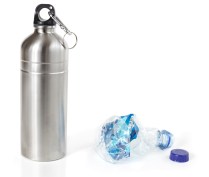
This is my favorite step, because it’s something that we can all easily start doing today. One of the biggest things you can do to reuse is to eliminate any single-use items from your life. This could include straws, plastic utensils, plastic bags, napkins, coffee cups and water bottles. These items take materials and effort to produce and transport, all for about 10 minutes of use. And because it never breaks down, every single straw or fork you’ve ever used is out there is the world right now. Gulp.
Invest in a stainless steel straw, or don’t use one at all! Unless your jaw is wired shut, you don’t actually need to drink from straws. Dust off the reusable water bottles and coffee cups you undoubtedly have somewhere at home, or invest in a nice stainless steel or glass option. Bring in a cloth napkin and utensils from home, or pick up some travel bamboo utensils. Disclaimer – you will get weird looks from people when you eat your yogurt with a bamboo spoon, but it’s a great opportunity to start a discussion about the impact of reusables.
- Recycle
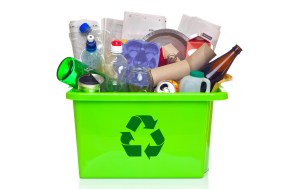
This is the step we’re all probably the most familiar with, but I’m going to encourage you to stop thinking about recycling as the hero in the battle against climate change. Yes, recycling is an amazing thing and we should all do it. But recycling doesn’t make things magically disappear. Did you know only about 9% of plasticis recycled? There are many reasons for this – some of these items are thrown in the trash, many municipalities don’t have the resources to keep up with the recycling, or there isn’t much as much demand for recycled materials. It is much better to refuse these items in the first place than to use them and then need to recycle them.
Another side of the coin with this step is to make sure you are buying recycled items. Recycling is a business, and there needs to be demand for recycled goods in order for recycling to work. My favorite recycled items purchased recently are sippy cupsmade from recycled milk jugs and cute flatsmade from recycled water bottles.
- Rot
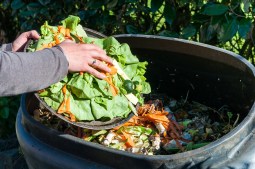
Rot refers to composting organic matter rather than throwing it in the trash. Organic matter that can be easily composted usually refers to vegetable peelings, cores, pits, eggshells, coffee grounds, bread and even paper – basically anything except meat, bones and dairy.
What’s the big deal, doesn’t food just decompose anyway? Unfortunately no – it needs air in order to decompose and trash is packed really tightly. So instead, the food breaks down and releases harmful greenhouse gases such as methane which damages the atmosphere. By composting, the food turns into nutrient rich soil. One bonus I’ve noticed since composting is that our trash doesn’t smell anymore, so we take it out less often resulting in less plastic garbage bags. #winning
There are a few different ways to compost with varying degrees of difficulty:
- Beginner – Sign up for a curbside composting program. The company will provide you with a bin and pick it up when it’s full on a weekly/bi-weekly basis.
- Intermediate – Find a place to drop off your compost in your local community. The City of Boston has a pilot program called Project Oscar(as in, Oscar the Grouch) that I participate in. We have a 4-gallon container that we keep on our deck and once it’s full, we empty it at a local community center. Whole Foods also offers compost at their locations as well.
- Advanced – Do it yourself! I haven’t quite taken the plunge to go down this route, but I’m told it’s actually pretty manageable. You can up a compost unit in your yard where you put in your organic matter, mix in wood chips and rotate every once in a while. There are also worm compost units that you keep in your house. Simply put your items in there (except onions, apparently the worms hate onions) and they happily munch away and turn it into soil.
So that’s it! Five easy guidelines to start you on your path to being more eco-friendly. Pick a few small things to start with, and see how they work out for you. The choices you make every day matter, and you can make a difference.
My family of three has been following these steps for several months and a few weeks ago we actually didn’t need to take out our trash or recycling bins because they were almost empty. Which is great, because taking out the bins is a big pain. And reducing landfill waste is cool too.
Happy Earth Day!
 eco chick
Great post! Happy Earth day!
Sent from my iPhone
>
LikeLike
Love the Earth Day post! I’ve been meaning to start composting… maybe I can finally do it this year.
FYI – there are no polar bears in Antarctica 🙂
Cheers, Brandy
>
LikeLike
Ha! Shows how much I know! Thanks for your wisdom, world traveler!
LikeLike