
I know what you are thinking – vegans are malnourished freaks who get no enjoyment out of life, right? Well, let me start by saying I never, ever, EVER thought I would consider going vegan. But here I am. Turns out – vegans are normal people (gasp!) and they just might be smarter than the rest of us.
I’ve been a meat eater all my life. Most, if not all, of my favorite meals include meat and animal products. We’re taught that meat, especially lean white meat, is a vital part of a healthy diet. And dairy is a key component to preventing osteoporosis. In fact, meat and dairy are 2 out of 5 main components of the food pyramid. Not only are these foods supposedly healthy, but they are delicious, and what is life without delicious food? Would a trip to New Orleans be complete without jambalaya? Or a summer without lobster? A birthday without cake and ice cream? I digress. One of my closest friends is a vegetarian, and quite honestly, I’ve been pretty judgmental over the last eleven years that we’ve been friends (sorry, Mal!). We met while studying abroad in Spain, where the majority of my favorite foods include animal products – jamon Serrano, tortilla Espanola, café con leche, manchego cheese…even now I’m drooling a bit thinking about it.
Most of my adult life I’ve been focused on finding the best diet for me so that I can enjoy life but also maintain a healthy weight. Weight Watchers, low carb, South Beach Diet – I’ve tried it all. Recently, I had the most success with the Whole 30 – a popular 30 day paleo detox where you cut out grains, legumes, alcohol and dairy leaving you with meat and produce. Not only did I lose weight during these 30 days, but my skin cleared up, I didn’t get any headaches and my persistent heartburn went away. As recently as a few months ago, I sincerely believed a paleo diet was the way humans were meant to eat.
So how did I get here? I originally stumbled into this while looking into ways to life a more eco friendly life. I was innocently perusing movies on Netflix and came across the documentary “Cowspiracy.” It completely opened my eyes to the damaging animal agriculture industry and made me question everything I had been taught about health.
After doing quite a bit of research and watching more documentaries than I’d like to admit, I’ve decided to explore what a vegan lifestyle would look like to reduce my environmental impact, improve my health and reduce the unethical treatment of animals and factory farm workers.
Environmental Impact
If you had asked me a few months ago how to live a more eco friendly life, I would have given you a pretty standard response: reduce your waste, take shorter showers, reduce the use of fossil fuels, turn off the lights when you’re not in the room, etc. I thought that the use of fossil fuels was the biggest cause of global warming. Never did I think that animal agriculture is just as bad, if not worse, than burning fossil fuels. Here’s the how:
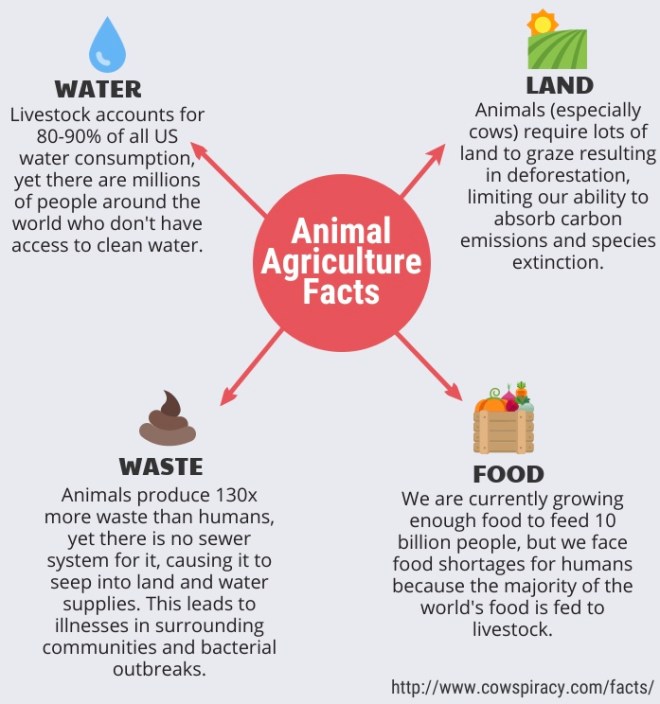
In addition to their land, water and food consumption and production of waste, cows also produce billions of gallons of methane, which is a greenhouse gas that leads to global warming.
Despite overwhelming evidence of the dire effects animal agriculture is having on our planet, we have probably never heard about this, even from any of the large environmental organizations. Why is this?
Cowspiracy aims to answer that question. The short answer is that the meat and dairy lobbies are so powerful that they stop at nothing to cover up this information, and even promote animal consumption as a necessary part of a healthy diet. People who try to speak out against these powerful organizations have wound up in jail or dead. Did you know that they even went as far as to sue Oprah because she dared to say she didn’t want a mad cow infested hamburger?
The way we are currently living is not working. Having a young son drives this point home for me. I used to think that the effects of global warming wouldn’t happen for hundreds of years, but we are feeling them now. What will my son’s life be like? What about his children? Will they have to endure stronger than normal natural disasters? Could they be infected with e. coli? Will they be at risk for asthma because of air pollution? This is not working, and we can’t ignore that any longer.
Health
Reducing our meat and animal product intake can also have enormous health benefits. The creators of “Cowspiracy” created a second film called “What the Health” that delves into this topic further.
This film details the many studies that have been done that prove that a diet that includes meat and animal products is linked with certain illnesses. I knew some cancers had clear causes (heavy drinking causes liver cancer, smoking causes lunch cancer, for example) but that many others were just the luck of the draw. Yes, eating healthy and exercising could help a little bit, but how many healthy people do you know that have gotten cancer? I can think of several people in my life who were doing everything right and still managed to get cancer. Turns out, while there is no way to guarantee you will never get sick, switching to a plant-based diet can prevent certain illnesses.
The makers of “What the Health” found another conspiracy at work – major healthcare corporations turning a blind eye to the root causes of issues and giving wrong advice to sick people. One example is the Susan G. Komen foundation. At first glance, the foundation is doing amazing work to spread awareness and work toward finding the cure for breast cancer. But there is considerable evidence that dairy consumption is linked with breast cancer, yet the Susan G. Komen Foundation aligns themselves with the yogurt company Yoplait. Turns out, many of these organizations are more than happy to compromise their message in order to accept donations from corporations looking to push their agenda. More information about how the foundation became a “pink clad right-wing sorority of sanctimonious hypocrisy” can be found here.
The idea that our diet can have adverse effects on our health is a personal topic for me as my son suffers from multiple food allergies. We first knew something was up when he was just a few months old and his body was covered in scaly, oozing eczema and cradle cap. We were told to put him to bed in wet pajamas, cover him with prescription steroid creams, and put bleach in his bath (yes, really). When he was a few months older, we were able to do a blood and skin test to see what he is allergic to, and discovered he has food allergies to peanuts, tree nuts and eggs and has environmental allergies to cats and dogs. Eczema and allergies usually go hand in hand with asthma, and my son is enrolled in a clinical trial to try a certain medication to try to prevent asthma. He’s already had one episode with his lungs where we had to use a nebulizer and an inhaler to help with his breathing.
And he is not alone. Food allergies have increased by 50% from 1997 to 2011 and no one seems to know why. I don’t have the smoking gun when it comes to identifying the cause of his allergies or ailments, but I have an educated guess. Over the last few decades, the way that we grow and prepare food is radically different. Animals are bred to be bigger, the food they are fed is genetically modified to make them fatter and since they are so susceptible to diseases because they live in such close quarters, they are preemptively pumped with antibiotics. When it comes to industrialized farming, we use so many pesticides that we aren’t getting exposed to some of the good bacteria that we used to get. I also have concerns about humans ingesting pesticides. In addition, a lot of the food that we are marketed to is getting progressively less and less natural – fruit snacks, hot dogs, chips, soda, fruit juice, anything from a fast food restaurant, etc. Should we really be surprised that people are sicker and fatter than ever? While I was pregnant, I tried my best to be healthy and not “eat for two” but I definitely indulged more than I normally would. And meat and dairy were mainstays in my diet. Could the consumption of these items have led to my son’s allergies? I’ll never be able to get a definitive answer, but the thought definitely gives me pause.
In addition to the allergies, my son is iron deficient, has a constant ear infection and goes from one cold right into another. I know kids get a lot of sicknesses from daycare and they need to build up their immune system, but this doesn’t seem normal. We’ve been to 8 different departments at Boston Children’s Hospital and have had to miss time at work to take him to different appointments or drive over to daycare to administer treatments.
Why is it that every time he is sick, we are only met with a medication to give him? No doctor has ever tried to identify the root cause. “What the Health” has a particularly cynical view that there is more money to be made medicating sick people than trying to prevent sickness in the first place. We have unfortunately found this to be true.
Think about the healthcare debates that have happened over the last decade in Washington and our struggle to provide adequate care to Americans. What if we were able to prevent more illnesses that insurance has to cover – wouldn’t that be more effective than trying to figure out a way to both lower costs and expand coverage? Why has that never been brought up as a solution?
Switching myself and my toddler to a vegan diet is certainly daunting. But not as daunting or scary as the thought of him developing a more serious illness, or needing to keep him continually medicated as we have been. Sometimes I lay awake at night worrying about when he’s older and running around with his friends in the woods. Is he going to need to run around with an epi-pen and an inhaler? What if he forgets them? If his allergies, eczema, asthma, and ear issues could be attributed to meat and dairy, why the hell wouldn’t I at least try to find out?
[Note – I am changing my son’s diet under the supervision of our pediatrician.]
Ethics
For many people that go vegetarian or vegan, ethical reasons might be the driving force behind their decision. Initially, this was at the bottom of my list, but the more I learn the more I am concerned about the ethics behind animal agriculture.
When you are a meat eater, you always know that the meat you are eating originally was an animal. But I think we force ourselves to mentally disconnect that thought. We even have different names for some meat – beef instead of cow, pork instead of pig, etc. Which makes sense, can you imagine ever ordering “baby cow piccata” at a restaurant?
This is what actually led my friend to become a vegetarian. She grew up on a small farm and got to know these animals, and was horrified at the thought of them being sent to slaughter. I’ve been to her farm, which is in a beautiful spot in Gettysburg, Pennsylvania and has been family owned for generations. Unfortunately, the majority of the animals bred for meat do not live in such idyllic locations. They face lack of space, overcrowding, having medical procedures without anesthesia, illnesses and abuse.
As I began to learn more and more, I thought “ok, well I wont eat meat but I will still have dairy and eggs since those animals don’t get hurt.” Unfortunately, that isn’t the case either. Dairy cows can only produce milk when they recently have given birth, so they are impregnated over and over again to keep their supply going. This milk is produced for the baby calf, but their babies are taken away from their mother just days after birth. Female calves are raised to be dairy cows themselves, but male dairy cows are kept tied up so they can one day become veal. As for egg laying hens, they also face horrific conditions. They beaks are burned off shortly after birth, they live in extreme confinement amid their own waste. After they are done laying eggs, they are sent to slaughterhouses but they are usually too sick so their meat can only be used to feed other animals. However, some meat from sick chickens has found its way to the National School Lunch Program. As for male chicks, they have no use for them so they are put into a grinder while they are still alive. There are animal cruelty laws, but farm animals are not protected by them. In fact, there are laws that make it illegal to expose unethical treatment of animals. In many states in the United States, being an animal rights whistleblower is worse in the eys of the law than actually abusing animals.
In addition to the unethical treatment of animals, there are many humans that are hurt by animal agriculture:
- Lower income communities – Duplin county North Carolina has the highest concentration of hog farms in the United States. Pigs excrete more than 10 times the waste that humans do, which is collected in pools and then sprayed into the air. This obviously smells horrible, and affects the quality of life of the roughly 60,000 nearby households made up of primarily Black, Latino and American Indian people. Not only are these people stuck inside their houses, but they’re also at risk for infections and diseases. Retired hog farmer turned Republican House Representative (and collector of donations by hog companies) Jimmy Dixon sponsored a bill to limit the amount of damages victims could collect. He encouraged them to ignore the putrid smell and instead “close [their] eyes and imagine how ham and sausage and eggs and fried chicken smell.” This is so much more than a decision about what you put on your plate; it’s become a civil rights issue.
- Third world countries – Our meat consumption has far reaching consequences besides the United States. We currently grow enough food to feed 11 billion people, yet 9% of the world is starving or undernourished. How can that be? Our appetite for meat in our diets has increased so much that we’ve decided to feed a fourth of our food supply to animals. I always thought world hunger existed because there wasn’t enough food. The thought that enough food exists, we’ve just decided to reallocate it so that certain rich countries can eat meat is infuriating. In fact, 82% of the world’s starving children live in countries where food is fed to animals that are eaten in developed countries. With the world population expected to grow from 7 billion to a projected 11 billion in 2100, this current model of food production is not sustainable to ensure that all people have access to a healthy diet.
“Conversion to plant based food systems in developing countries would feed more people more nutritiously with more efficient use of their resources, improve long term soil fertility, create economic opportunities, all of which would provide a path toward breaking the poverty and hunger cycle.”
http://comfortablyunaware.com/blog/the-world-hunger-food-choice-connection-a-summary/
- Animal agriculture workers – While meat and dairy companies are flourishing and enjoying their stronghold on Congress, many of their workers are suffering. For example, most chicken farmers have borrowed over $500,000 but only earns about $18,000 a year. They are under the thumb of their employer, and forced to comply with any facility upgrades or process changes. Bloomberg Businessweek also shed a light on another set of mistreated animal agriculture workers – slaughterhouse sanitation workers. Many are undocumented immigrants who are thankful to have found a job. The company uses this as leverage to take advantage of them. Not only is this work disgusting and includes cleaning up blood, waste and bones off the floor, but it is dangerous. They clean the machines while they are still on, and are at risk for serious injuries and even death. Should that occur, their employers rarely pay out any damages, and the victim will be lucky to get their medical bills paid. And under the Trump Administration, OSHA has been more lax about regulations and has issued one-fifth the number of press releases detailing companies who are mistreating workers.
So – what now?
Now, I’m not committing to going 100% vegan for the rest of my life starting now. I believe with every goal or change, it needs to be done in a realistic and responsible way. To start going down this path, I’m taking part in Veganuary along with 150,000+ of my closest friends. I’ve committed to going fully vegan for the month of January and then reassessing the situation. Will I simply reduce my meat intake in the future? Will I be a vegetarian instead of a strict vegan? Or will I continue to be vegan? Who knows, but it’s worth looking into it. I’ll report back with an update on where I land and any guidance for others who’d like to explore this as well.
And lastly, a request. Giving up meat forever is a lot to ask. But if everyone considered decreasing his or her intake, it’s a great place to start. Try a new recipe for Meatless Mondays, check out plant-based milk, fill your plate with more vegetables, or look to buy humanely raised meat instead of factory farmed. If everyone starts going down this path, however slowly, it would make a huge difference. Thank you.
 eco chick
One Comment